article
Three critical AI trends shaping customer experience in 2026

January 26, 2026 • 5 minutes
For the last two years, we’ve seen brands invest heavily in AI with mixed results. Some of those mixed results have been very public failures, and CX leaders are wary, even though they’ve recognized the potential. Balancing risk and reward is a tough ask, and honestly, CX vendors shouldn’t expect brands to take on significant risk to see the benefits of AI.
The benefits of AI have also been elusive. In 2025, McKinsey found nearly 8 in 10 enterprises deploying GenAI saw no meaningful bottom-line impact. An MIT study reported 95% of AI pilots fail to deliver value, and Gartner predicted that over 40% of agentic AI projects will be canceled by 2027 due to unclear value or poor governance.
Thankfully, we’re starting to see this era of AI hype with too many risks and not enough results coming to a close. Now, it’s all about real results without the risk. How are CX teams getting there? Brands are shifting their focus from broad GenAI applications to well-defined use cases with clear priorities that focus on reliability, adaptability, and measurable value at the forefront.
That leads me to the first 2026 trend our experts at LivePerson highlighted in our recent webinar.
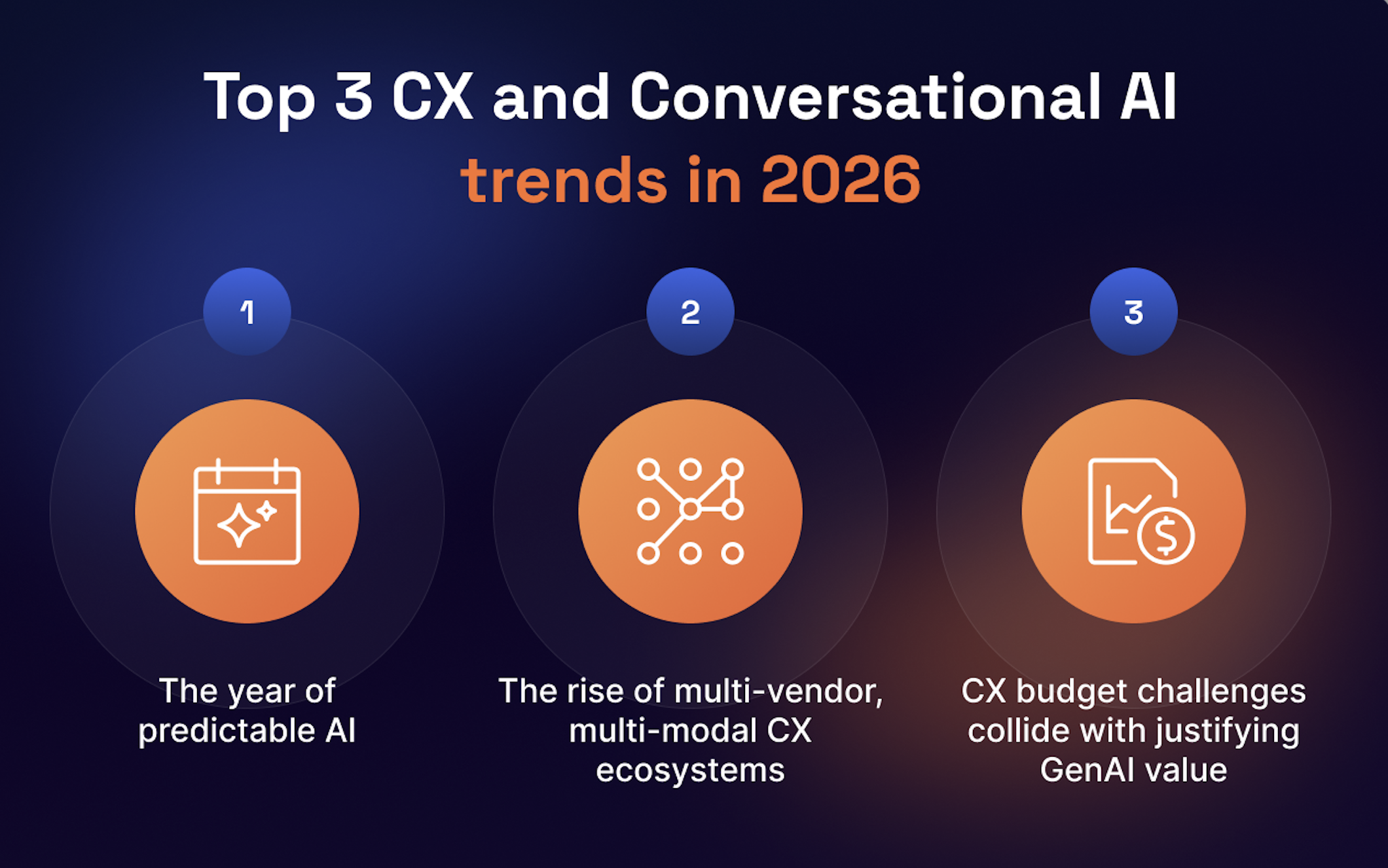
1. Focusing on predictable AI to unlock AI adoption
Brands are reducing risk by focusing on predictable AI.
In practice, this looks like combining strong guardrails with continuous testing to validate and verify the output of GenAI. Validation used to be a manual process where teams had to test conversation samples, review edge cases, and validate AI agent or bot behavior one scenario at a time. The opportunity in 2026 is building predictability into AI systems with simulations and an assurance layer rather than testing manually or with live customers.
How can CX teams benefit from predictable AI?
CX teams benefit from predictable AI because predictability reduces risk, which makes it easier to move GenAI from POC to production. Many of the roadblocks to using AI with customers come from internal security and AI governance concerns. The challenge with AI governance and security is that, even after working through long checklists, you still don’t know how effective your guardrails are until you’ve done extensive manual testing (that often misses edge cases) and turned on AI agents with live with customers.
To get started, build a CX assurance layer that lets you test, verify, and continuously validate GenAI in simulated environments. Data from your tests will help you fine-tune and then validate your AI outputs. That way you know your guardrails work before your customers find out they don’t.
2. Prioritizing open ecosystems over locked-in technologies
The CRM, CCaaS, conversational AI, and digital platform market is going through rapid change as vendors work to adapt to the new needs of brands and consumers. We’re seen two primary strategies emerge: consolidate into a closed system or integrate aggressively with an open ecosystem approach.
Salesforce and NICE stand out as the two main contenders who are asking you to bet on them for the next 10-20 years because once you’re in their platform, you’re locked. LivePerson and Genesys are two that have taken an open ecosystem approach that allows brands to mix and match across the best of technologies. If tomorrow you need to integrate with a different CRM that benefits you more, are you able to make the switch without significant disruption?
What should CX teams prioritize when evaluating conversation platforms?
CX teams should prioritize conversation platforms that allow you to customize an ecosystem that works for you and your customers and allows you to adapt as your priorities change or technology evolves. This is a strategic decision that will impact your future success.
The worst experience is to get locked into a platform that makes it difficult for you to adopt the latest innovation. Contact center leaders know the pain of multi-year migrations from on-prem to cloud-based contact centers. A CCaaS that doesn’t have an open ecosystem will give you on-prem flashbacks. Choose your technologies not just based on current capabilities but also based on their partner and integration strategies.
3. Leveraging proactive intelligence to drive budget justification
The third component influencing 2026 trends is money. Follow the money in CX and you’ll see budgets have stalled and CX teams are obsessing over reactive metrics vs proactive insights. Unfortunately, reactive metrics don’t give CX teams a strong business case for budget.
A Forrester survey of CX professionals in 2025 found that 48% of respondents said they were not effectively able to show a relationship between CX metrics and business outcomes. An additional 2% said they had no way to make that connection to business outcomes.
In 2026, CX teams are starting to expand their definition of good CX beyond legacy metrics by understanding customer patterns, predicting behaviors based on past interactions, and finding the pain points in customer journeys. Plus, many CX teams are focusing on revenue generating metrics where they can identify buying signals and revenue opportunities. This provides a much stronger case for justifying CX budget.
How can CX teams justify the budget in 2026?
CX teams can justify increasing or maintaining their budget by building advanced CX analytics capabilities that focus on proactive, data-driven insights that tie into company goals and revenue-generating activities.
What this means going forward
These three trends connect. Predictability makes it possible to continuously prove value. Diversification enables predictability by matching AI capability to requirements. Budget pressure forces both.
Brands that navigate these trends successfully will unlock the ability to leverage AI in CX and prove ROI that unlocks budget.
Want to go deeper on these trends? Watch the complete discussion with our CX strategy team as we unpack predictable AI, multi-vendor ecosystems, and how to prove ROI in today’s budget environment.