article
What to do when AI governance decides who in CX can scale and who can’t

Key takeaways:
- AI transformations stall when organizations treat AI as a technology rollout instead of an operating discipline.
- The LivePerson Transformation Propensity framework identifies seven readiness pillars, from executive alignment to AI governance, that determine whether AI delivers measurable outcomes.
For the past two years, the AI conversation inside customer experience organizations centered on one question: what can this technology do? That question has been answered. Generative AI drafts responses. Agentic AI resolves tickets. Conversational AI routes, recommends, and increasingly, acts on behalf of a brand.
The question CX leaders now face is harder. Where should AI act, and what will actually change as a result? That shift, from possibility to accountability, defines 2026. Forrester put it plainly: after a turbulent 2025 marked by overly enthusiastic AI ambitions, deepening CX fatigue, and ongoing economic volatility, “successful firms will forgo the hype and focus on tangible outcomes, trust, and customer value” in 2026, according to the firm’s research.
That reset matters because most organizations still conflate a working demo with a working deployment. The technology is rarely the obstacle. The organization around it usually is.
Why do AI transformations fail in CX even when the technology works?
A great demo doesn’t guarantee a great deployment, and a great deployment doesn’t guarantee a great outcome. Three gaps show up again and again across enterprise AI programs:
- The ambition isn’t shared across business, technology, risk, and operations leaders.
- The organization isn’t culturally ready to redesign how work actually gets done.
- Investment stops at the pilot instead of funding production-grade infrastructure.
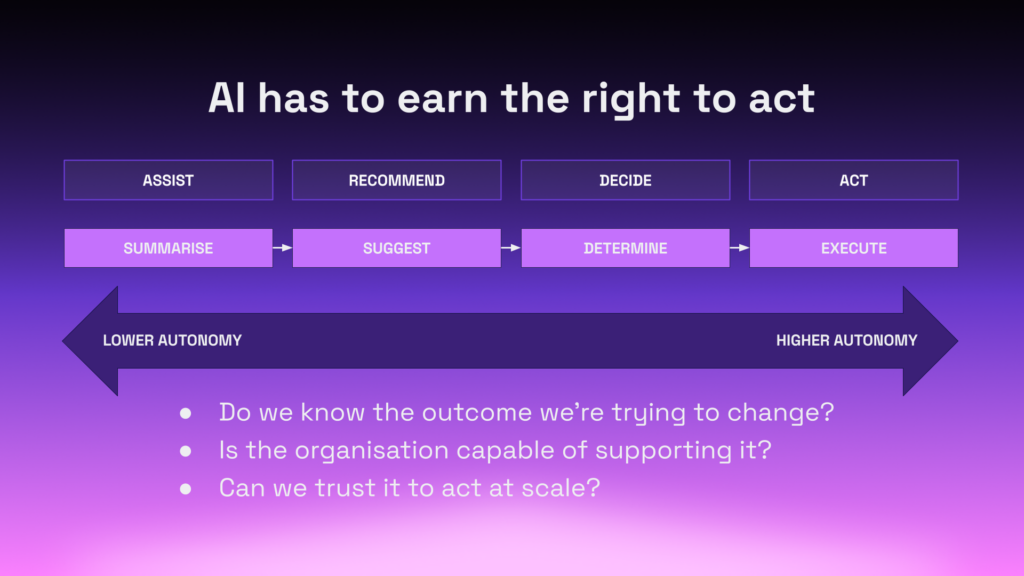
AI has to earn the right to act. Every deployment sits somewhere on a spectrum from assist to recommend to decide to act, and the further AI moves toward autonomy, the more the organization needs to know the outcome it’s trying to change, whether it can trust the system to act at scale, and whether it has built the guardrails to make that trust defensible.
The seven pillars of AI transformation readiness
LivePerson’s Transformation Propensity framework evaluates organizational readiness across seven pillars, turning a subjective question (how mature is our AI?) into a measurable one (how ready is our organization to turn that AI into an outcome?).
- Executive alignment. Cross-functional ownership and shared financial accountability across business, technology, risk, and operations leaders, not a single departmental sponsor.
- Cultural readiness. The organization’s willingness to dismantle legacy processes and design human-and-AI workflows together, rather than layering AI onto how things already work.
- Investment appetite. Funding that extends past point-solution pilots into dedicated, long-term capital for production infrastructure and measurable ROI.
- Data and technology openness. An interoperable, modern data architecture that can power agentic orchestration instead of a legacy, siloed stack.
- Strategic vision. A clear roadmap that defines AI versus human ownership across high-impact customer journeys, replacing ad hoc, reactive problem-solving.
- AI governance. The frameworks, tools, and oversight mechanisms needed to test, deploy, monitor, and audit autonomous agents safely, using pre-live simulation and real-time guardrails.
- Teams and skills. A workforce with the technical competency to redesign ways of working, not just use AI tools on the side.
Each pillar follows its own maturity path, from foundational to innovative, and most enterprises score unevenly across them. A bank might show strong executive alignment and investment appetite while its governance model remains unfit for the agentic use cases it wants to pursue. A telecom might have a clear strategic vision but a legacy tech stack that blocks the integrations agentic AI needs to work.
Where does enterprise AI adoption stand in 2026?
The data tells a consistent story: adoption has outpaced readiness.
Eighty-eight percent of CEOs say their organization is actively adopting AI agents in at least one business area. Yet only 25% of AI initiatives have delivered their expected ROI, and just 16% of enterprises are focused on scalability and readiness at an enterprise-wide level, according to research from McKinsey & Company, Deloitte, IBM, and LangChain.
Enterprises are shifting from experimentation into operationalization. Value realization and ROI now matter more than novelty, and scalability and readiness have become the leading concerns for CX and technology leaders alike. LivePerson’s own Conversational Growth Paths maturity model, built from benchmarking data across major verticals, tells a similar story: most brands sit at the early-to-middle stages of conversational maturity, well short of the predictive, AI-orchestrated experience they’re aiming for.
4 reasons AI initiatives stall and how to jumpstart
Four recurring failure points stall AI programs after the pilot stage:
- Lack of cross-functional ownership. A single executive sponsor isn’t enough. Initiatives need shared accountability across business, technology, risk, and operations, with every team member acting as a builder, not just a manager.
- No workflow redesign. Many enterprises hand teams a powerful AI tool and expect productivity gains without redesigning the underlying process. Worker skills, not the technology, end up as the biggest barrier, and the organizations that succeed are the ones reimagining jobs and workflows around human-and-AI collaboration.
- Lack of integrations. Agentic AI depends on proper integration and orchestration to deliver real governance and interoperability. A dated tech stack, or an over-engineered one built without scalability in mind, blocks that outcome before it starts.
- Evaluation gaps. As AI scales across functions, the absence of clear policies and accountability frameworks produces unpredictable agent behavior, especially once that AI meets real-world data and edge cases it wasn’t tested against. This is where AI governance and AI assurance diverge: governance sets the rules, while assurance, through pre-live simulation and continuous monitoring, proves those rules hold up once AI is live.
How can organizations assess their AI transformation propensity?
A structured self-assessment across the seven pillars gives leaders a way to move from guesswork to a prioritized plan. The process works in two parts.
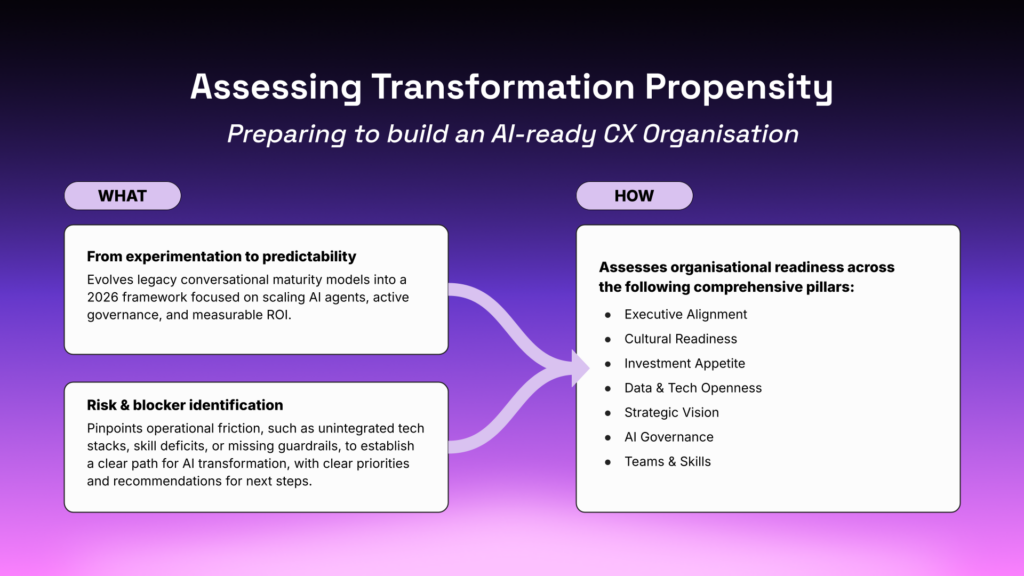
First, evaluate each pillar on a five-stage maturity scale, from foundational to innovative, and plot the result on a radar chart. Second, use that visual map to identify the biggest gaps, the pillars scoring lowest and closest to the center, and treat them as the immediate priority for any new AI or digital transformation program.
This matters because the biggest gap is rarely where leaders expect it. A UK bank serving 25 million retail customers scored high on executive alignment, investment appetite, and cultural readiness, but its AI governance model, built for a different era of technology, had become the single largest blocker to scaling agentic AI safely.
The goal isn’t more AI, it’s better outcomes
Technology was never the whole answer. Someone has to own the transformation. People have to embrace it. Investment has to follow the ambition. Data and technology have to support it. Everyone needs to understand where the organization is going. And governance has to give leaders the confidence to scale what they’ve built.
The organizations getting this right in 2026 aren’t doing the most with AI. They’re being deliberate about where they use it, clear about the experience they’re trying to change, and disciplined about the governance that lets them trust AI with more responsibility over time. AI earns the right to act through readiness, not ambition. Start by assessing where your organization stands across the seven pillars, then build the governance model that lets you scale with confidence instead of hope.