article
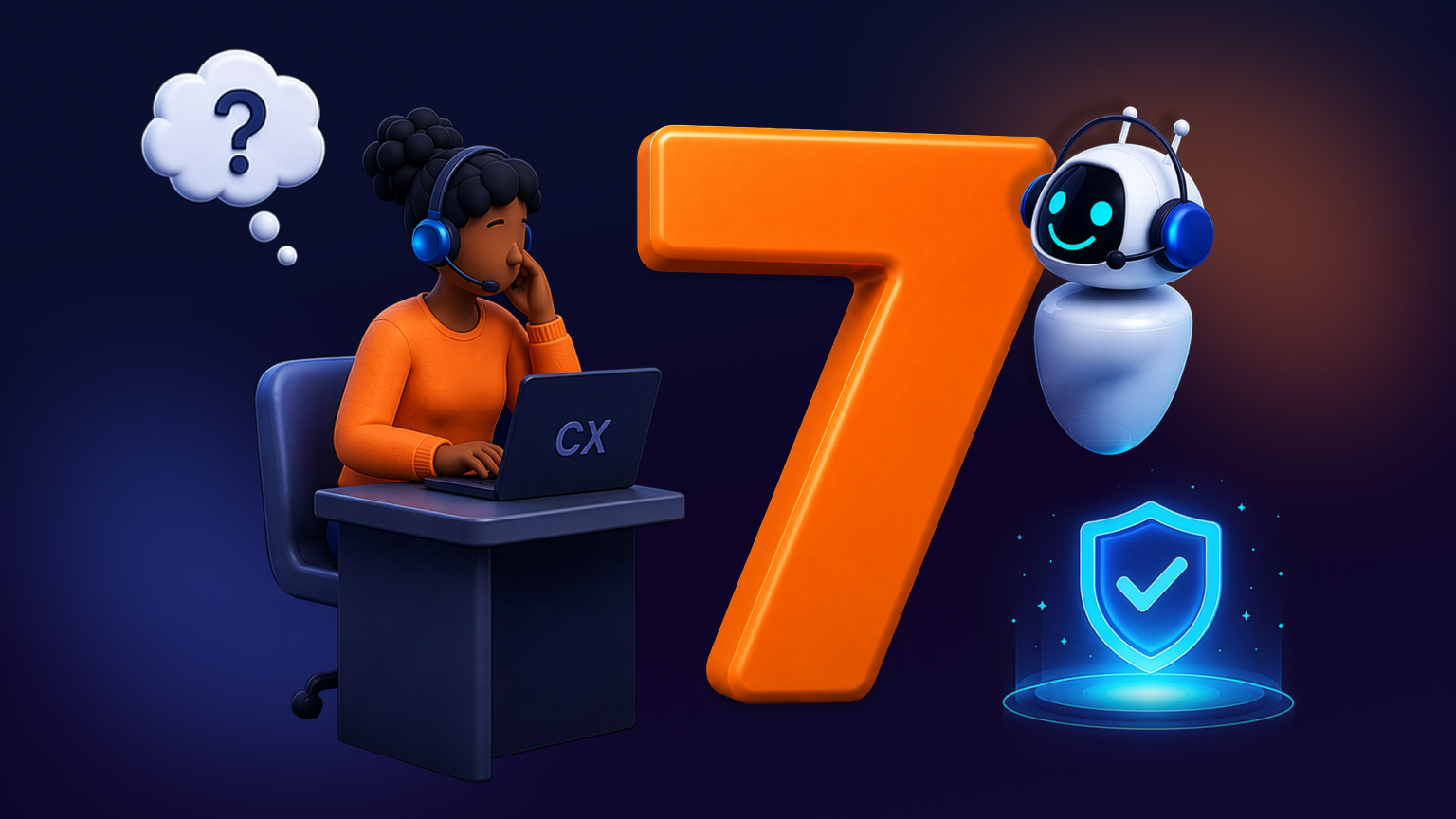
Seven AI governance misconceptions holding your CX team back from achieving AI assurance

May 07, 2026 • 5 minutes
Nearly every company has (or is working on) an AI policy, but almost none have true control over AI. Brands write policy documents, form an AI committee, and review edge cases after an incident, which is important, but AI policy is not the same as active control, and it falls short of AI assurance in CX. When AI agents interact with your customers thousands of times a day, a static policy document won’t stop hallucinations, compliance violations, or unexpected edge cases.
Manual Oversight fails at scale
Many brands assume they can govern AI through manual reviews, periodic audits, and retrospective reporting. This approach fails by design. As AI systems scale and adapt, traditional governance mechanisms break down.
You cannot manage real-time decisions with post-decision analytics. AI observation alone does not prevent harm. Without pre-deployment validation and runtime enforcement, monitoring is just a historical record of your mistakes. If you rely on humans in the loop to catch every error, you defeat the purpose of automation and introduce unscalable bottlenecks. Brands need concrete mechanisms to test behavior before deployment, observe execution, validate outcomes, and preserve evidence.
Enter AI assurance as a core component of AI governance
AI assurance shifts AI governance from intent to system-integrated evaluation. It operates inside the system of decision-making. Acceptable behavior is tested, enforced, observed, and proven continuously.
To make AI behavior predictable and safe, your assurance system must have three core components:
- Continuous conversation simulation: Test proposed changes, prompts, and workflows against explicit constraints before they reach your customers.
- Runtime evaluation and controls: Continuously evaluate AI and human actions during live execution. Block or escalate unacceptable behavior immediately.
- Preserved evidence: Automatically capture a complete, tamper-resistant record of every decision, input, and applicable rule.
When you build assurance into the system, governance becomes executable, and you’re able to replace trust with proof.
So what’s holding CX teams back from leveraging AI across the customer journey? Here are the top seven misunderstandings or fallacies that we see preventing companies from achieving AI assurance.
AI governance misconceptions are holding brands back from AI assurance
1. Our AI is trustworthy because we built it with good intentions.
This is the equivalent of running a bank without vaults and assuming everyone who walks in is honest. Good intentions are a starting point, but they’re not a strategy. Without measurable, enforceable safeguards built into your AI systems, you’re operating on hope. Modern AI governance requires objective, verifiable proof that your AI is operating within defined, acceptable boundaries—not just the assumption that it will behave as intended.
2. AI governance is a pre-deployment problem.
Many CX leaders believe AI governance is a checklist that needs to be completed before an AI agent goes live. This is a critical error. The real risks emerge during runtime, when your AI agent interacts with an unpredictable customer. Governance must involve continuous evaluation, real-time monitoring, and the ability to intervene instantly, which are non-negotiable for any AI application touching your customers or your brand.
3. Transparency means accountability.
Publishing your AI’s architecture or showing its decision-making process is not the same as being accountable for its outcomes. Transparency without control is just a window into failure. True accountability requires enforceable guardrails, the ability to block harmful actions before they occur, and an immutable record of every decision. Your customers don’t care if you can explain a mistake; they care that you prevented it from happening.
4. A human in the loop is our safety net.
Relying on human agents to catch AI failures in real time is an abdication of responsibility. In a high-volume contact center, can a live agent realistically monitor every AI-generated response for nuance, compliance, and toxicity while managing their own queue? Without automated tools, complete context, and the authority to act, the “human in the loop” can sometimes be a scapegoat, not a safeguard. Effective AI governance empowers humans; it doesn’t use them as a last line of defense for a flawed system.
5. Our static rules and policies are enough to manage AI.
A policy document sitting on a server won’t stop an AI from hallucinating. Predefined, static rules are brittle and cannot adapt to the infinite variability of human conversation. Your AI operates in a dynamic, unpredictable world. Your governance must too. Executable governance—where rules are coded into the system and enforced automatically—is the only way to manage the fluid nature of conversational AI at scale.
6. We can audit our AI for trust after the fact.
Retrospective audits are autopsies. They tell you what went wrong after the damage is done, after a customer has been lost, a compliance line has been crossed, or your brand reputation has taken a hit. This is reactive, expensive, and insufficient. The only way to trust your AI is to prove its safety and efficacy before and during every single interaction. Assurance must be proactive and continuous, built into the operational fabric of the AI, not bolted on as an afterthought.
7. We assume assurance persists after the system is deployed.
Once an AI system passes a pre-deployment review, organizations often treat its trustworthy state as permanent. However, AI is inherently adaptive; changes in data, model drift, and iterative updates constantly challenge previous assurance claims. Relying on past certification without continuous re-validation allows the integrity of your governance to implicitly degrade, which is a significant failure. Assurance must manage change safely, continuously proving that controls remain effective during runtime.
Transform your customer journey with predictable AI
For CX leaders, the pressure to deploy AI responsibly is massive. Brands need to improve customer satisfaction, increase retention rates, and cut costs. But you cannot scale what you cannot prove and continuously improve.
By moving from static policy to system-level assurance, brands gain the confidence to fully automate high-stakes workflows and unlock customer insights without exposing the brand to unmanaged risk. When AI is governable, it stops being a risk and starts being a measurable driver of lifetime customer value.
Don’t trust your AI, prove it with Syntrix
Do not wait for a catastrophic failure to realize your AI policy is just a piece of paper. It is time to enforce your guardrails, protect your brand, and turn conversations into measurable business outcomes.
Contact us for a demo of Syntrix today and see exactly how we can make your AI safe, predictable, and ready for enterprise scale.